Build Your Dedicated Offshore Accounting Team
Offshore accountants UK companies can rely on. Dedicated accountants from the Philippines supporting UK accounting departments inside your systems, your process, and your reporting cycle, with UK-hour coverage and strong data protection.

%20(2).png)


Our Clients
Trusted by 500+ Businesses



Why UK accounting departments are turning to offshore support
UK accounting departments are under more pressure than ever. Hiring is slower, salary expectations are rising, and many companies are finding it harder to build the internal finance capacity they need locally.
That pressure shows up everywhere. Month end gets heavier, reporting takes longer, payroll and reconciliations eat up time, and internal teams stay tied up in recurring finance work instead of focusing on control, insight, and decision support.
That is why more UK companies are turning to offshore support. It gives accounting departments a practical way to add capacity, reduce hiring pressure, and keep delivery moving without relying only on an increasingly difficult local talent market.
Hiring pressure
Local hiring is slow and expensive.
Capacity limits
Deadlines create constant delivery pressure.
Growth challenge
Scaling the firm becomes harder over time.
Is this right for your firm?
This model works best for firms that are ready to scale without growing local overheads.
 Mid-market UK companies with growing accounting and reporting needs
- Companies struggling to hire qualified finance staff locally
- Accounting departments with recurring workload across bookkeeping, payroll, VAT, reconciliations, and reporting
- Teams that need dedicated support, not a shared outsourced pool
- Leaders who want to stay in control of systems, process, and review
- Businesses looking to grow without adding more local headcount too early
If that sounds like your firm, this is built for you.

Build your offshore accounting team without losing control
The biggest concern most firms have is simple. Will the work still feel like ours? That question is fair, and it should be asked.
This model is built around dedicated offshore accountants working inside your systems and following your process. Your accounting department stays in control of approvals, review, deadlines, reporting standards, and day to day workflow. It is not a black box, and it is not a handoff that disappears outside your line of sight.
That is what makes the setup practical. You add capacity without changing the way your accounting department operates. Your offshore team fits into your workflow, your standards, and your reporting structure from day one.
Your systems
Work stays inside your tools.
Your process
Aligned to your workflow.
Your standards
You control quality, review, and approvals.
Your team
Feels like an extension of your finance function.
What your offshore accounting team can handle
Start with one area and expand when the timing is right.

Bookkeeping

Management accounts

VAT support

Payroll

Year end accounts

Compliance

AP and AR

Admin support
Trusted by Leading Firms

.png)


.png) 50%+ cost reduction
50%+ cost reduction- Quality and control maintained
- Fits into existing systems and workflow

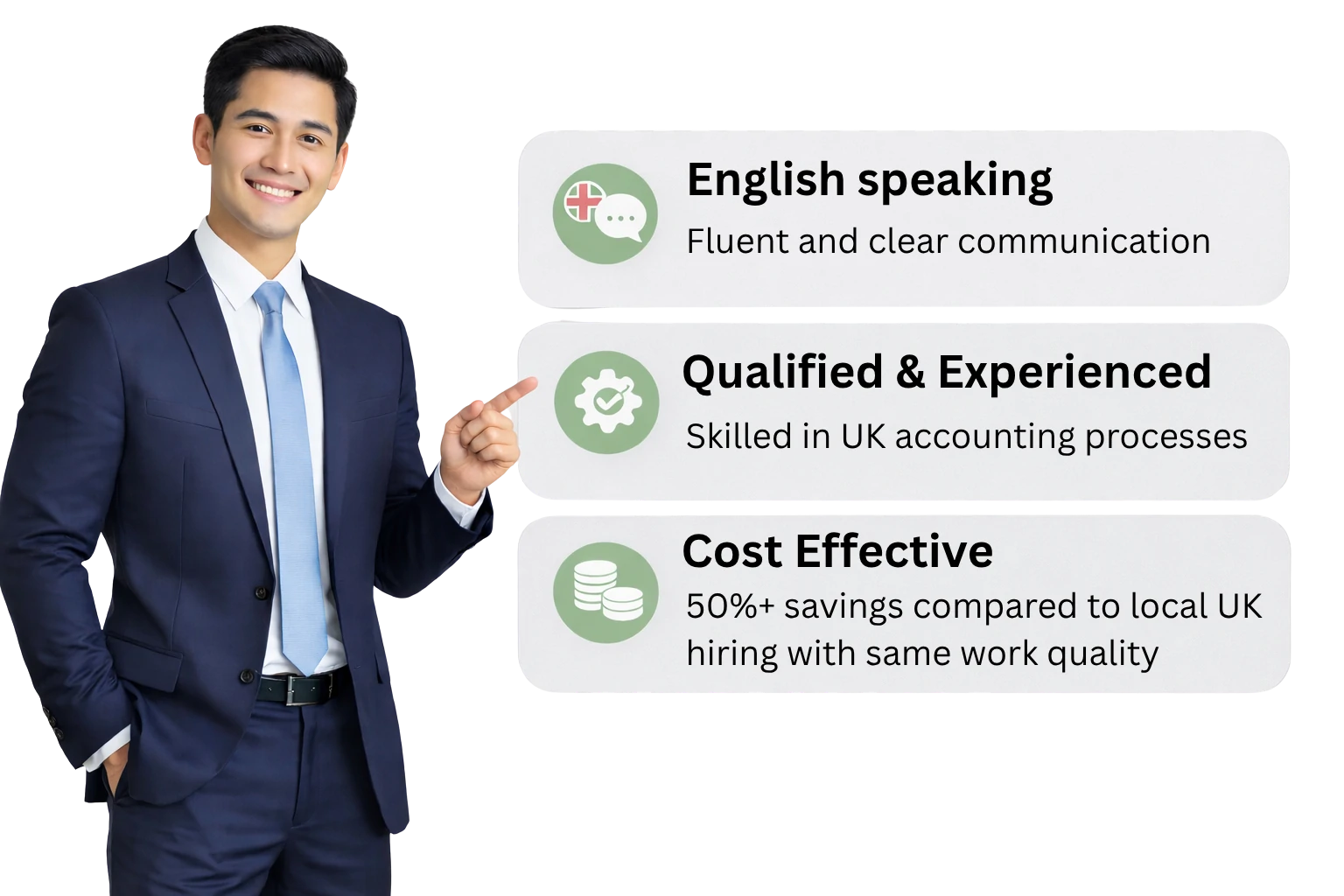
Why Philippines offshore accountants?
The Philippines is one of the leading destinations for offshore accounting talent for UK firms. The reason is not cost alone. It is the mix of communication, training, accounting capability, and day to day reliability.
That matters when you are adding people into your workflow. You need support that can fit into your systems, communicate clearly with your team, and work to the same review standards your firm already uses.
This is why many firms choose Philippines offshore accountants when they want a dedicated model that balances quality, stability, and cost. The real story is quality first. Cost is just one part of the decision.
Data protection and secure delivery
When you are adding offshore support, data protection matters. It is not optional.
That is why the delivery model is built around secure access, controlled workflows, and clear handling of finance data. Restricted access to systems, confidentiality controls, and monitored permissions all matter when sensitive financial information is involved. The proposal supports this with a controlled environment, NDAs, ISO 27001-inspired security practices, and authorised access only.
You get more support without weakening oversight, data handling, or internal control.
.png)
Secure access
Controlled access to systems and client data.
Confidentiality built in
Team members work under strict confidentiality and privacy policies.
Monitored permissions
Access is limited and only given to authorised team members.
Offshoring vs outsourcing — what is the difference?
The key difference is control.
Traditional outsourcing often uses a shared delivery model. That can work for some firms, though it usually gives you less control over workflow and makes consistency harder to build over time.
Offshoring gives you dedicated accountants, not a shared pool. Your team keeps the same systems, the same review process, and the same delivery standards. You get better continuity and stronger support without changing how your firm operates.
Traditional outsourcing
- Shared delivery model
- Less control over workflow
- Harder to build consistency
Dedicated offshore team model
- Dedicated accountants, not a shared pool
- Your systems and review process
- Better consistency and delivery
How to build your offshore accounting team
The best way to make this work is to start where the pressure is highest. Get the first area working well, build confidence in the workflow, then expand support once the model is settled.
That keeps onboarding low risk and practical. You are not rebuilding your finance function. You are adding capacity in a controlled way that fits around how your business already operates.
The process is structured. We start by understanding your workflows and role requirements. Then we match talent based on technical skills, finance experience, and software knowledge before moving into screening, interviews, onboarding, and integration.
Review your workflow
We look at your service lines and where delivery pressure is building.
Define the support model
We agree the type of work and how the offshore team fits your process.
Source and select talent
Candidates are screened, shortlisted, and shared for client interviews.
Onboard and scale
Your offshore accountants are integrated into your systems, then expanded as needed.

FAQs
What are offshore accounting services for UK businesses?
It is a model where dedicated offshore accountants support your business from another location while working inside your systems and process. That support can cover bookkeeping, payroll, VAT, reconciliations, month end, and reporting.
What is the difference between offshoring and outsourcing?
Offshore means a dedicated team inside your systems and process. Outsourcing usually means shared teams and less control, which makes consistency harder to manage.
Can offshore accountants work inside our systems?
Yes. They log into your software, follow your workflow, and work inside your review process. You stay in control of the work and the final output.
What software can your offshore accountants work with?
The team can work with common finance platforms such as Xero, Sage, QuickBooks, and other structured reporting systems. The goal is to fit into the tools your business already uses.
Why choose Philippines offshore accountants for UK businesses?
The Philippines offers strong English communication, qualified accounting talent, and experience working in international finance environments. It gives UK businesses a practical mix of quality, responsiveness, and cost control.
Will using an offshore team cause any compliance issues?
No. Your offshore accountants work under your supervision and to your review standards. Your business keeps control of process, approval, and the final output.
Can your offshore accounting team work UK hours?
Yes. The team can work UK hours for real-time collaboration, which makes communication easier and helps support feel like part of your business day.
How much can I save compared to hiring a local UK accountant?
A qualified local accountant typically costs between £35,000 and £55,000 per year plus overheads. With offshore accountants UK firms can often reduce that total cost by 50% or more while maintaining the same quality and control.
Will using an offshore team cause any compliance issues?
No. Your offshore accountants work under your supervision and to your review standards. Your business keeps control of process, approval, and the final output.
Can I start with one service first?
Yes. Many firms begin with one service line such as bookkeeping or year end support, then expand once the setup is working well. That gives you a lower risk way to test the model before growing the offshore accounting team.
See how offshore support could work in your firm

English speaking accounting professionals
Experience with Xero, QuickBooks, Sage, and UK accounting workflows
Clear reporting and consistent communication
Works UK Hours



.png)